The Structural Failure of Modern Health Data
If you walk into a hospital today, the most valuable thing you bring is not your insurance card. It is your biology.
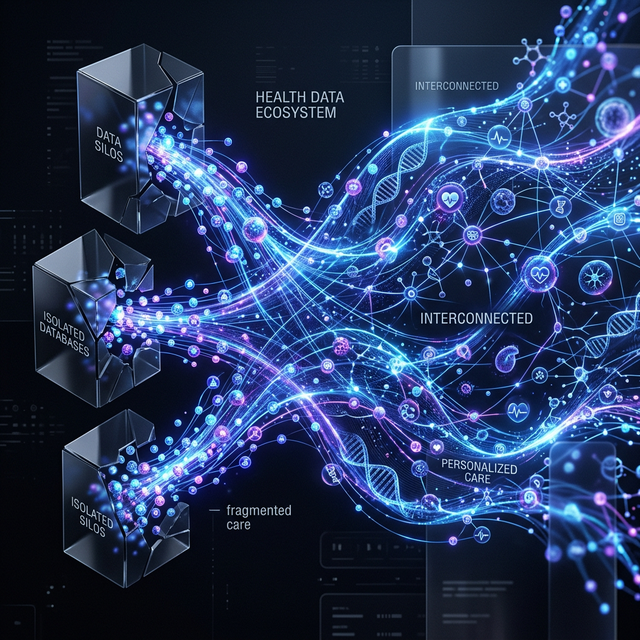
But look at what happens to the data extracted from your biology. The blood is drawn, the sequencing is run, the metrics are recorded. And instantly, that data is locked within a proprietary database owned by the institution.
This is the data silo problem. It is the single highest barrier to extending human healthspan today.
Why Silos Exist
Institutions don't silo data out of malice. They silo data because the legacy infrastructure of the internet made it the only viable way to operate. Before decentralized ledgers and standardized cryptography, if a hospital wanted to ensure data was secure, they had to build walled gardens.
But what was once a technical necessity has become a business model. Today, many digital health platforms consider your historical data to be their "moat" — the competitive advantage that keeps you paying their subscription.
The Consequence for Longevity
Biological data only becomes truly powerful when it is longitudinal and multi-dimensional.
A single blood test tells a doctor if you are sick today. Ten years of blood tests, cross-referenced with your nightly HRV, continuous glucose monitor, and genomic methylation data, tells an AI exactly how to optimize your biology to prevent you from getting sick tomorrow.
But because of silos, no single system has access to this complete picture. Your Apple Watch doesn't talk to your genetic sequencer. Your diagnostic lab doesn't talk to your Oura ring.
Breaking the Silo: The Architecture of Sovereignty
Data interoperability initiatives (like FHIR) have tried to force silos to talk to each other. But they keep the power dynamics the same: institutions still own the data, they just agree on a format to send it back and forth.
The Biological Sovereignty Protocol (BSP) flips the architecture entirely.
In BSP, data isn't sent between institutions. Institutions send data to the user.
- Your wearable writes
BSP-DVrecords to your BEO. - Your lab writes
BSP-LArecords to your BEO. - When you want an longevity AI to analyze your health, the AI reads from your BEO.
The silo is dismantled not by forcing companies to share, but by making the human being the absolute center of gravity for their own biological data. This is what we mean by Biological Sovereignty.